Comparison between the Yamaha XSR 155 and the Royal Enfield Hunter 350 can be challenging, as both bikes offer stylish designs, modern features, and are well-suited for everyday city riding. However, they cater to different types of riders. The Yamaha XSR 155 is a lightweight neo-retro motorcycle known for its agility, performance, and fuel efficiency. In contrast, the Royal Enfield Hunter 350 is a relaxed and torquey street bike designed for comfortable cruising and strong low-end power
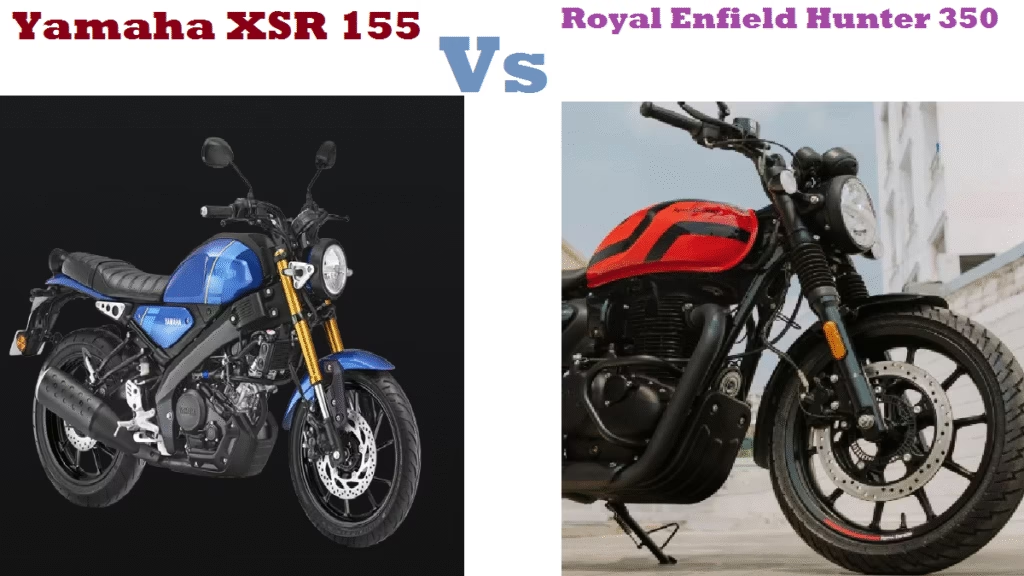
In this comprehensive comparison, we outline the key differences between the two motorcycles, focusing on engine performance, weight, fuel efficiency, features, and price. We also provide tables and pie charts to help you easily determine which bike best fits your riding style and daily needs. Whether you prefer sporty handling or classic comfort, this comparison will guide you in making the right choice.
Classification
- Yamaha XSR 155 — Neo-retro / modern-standard roadster. Lightweight, high-revving 155cc liquid-cooled single; aimed at city riders who want sporty handling and modern features in a retro package.
- Royal Enfield Hunter 350 — Neo-classic / small cruiser. Heavier, torquey 350cc long-stroke single tuned for low-end pull and relaxed cruising; aimed at riders wanting classic RE character and a comfortable street cruiser.
Specification Table
| Sp. | Yamaha XSR 155 | Royal Enfield Hunter 350 |
|---|---|---|
| Engine | 155 cc, liquid-cooled, single | 349.34 cc, air & oil-cooled, long-stroke single. |
| Power | 18.4 PS @ 10,000 rpm. | 20.2 PS @ 6,100 rpm. |
| Torque | 14.2 Nm @ 7,500 rpm. | 27 Nm @ 4,000 rpm. |
| Kerb weight | 137 kg. | 181 kg. |
| Seat height | 810 mm. | 790 mm. |
| Fuel tank | 10 L. | 13 L. |
| Claimed mileage | 45.5 kmpl (manufacturer/portal claim). | 36.2 kmpl (claimed). |
| Brakes & electronics | Front & rear disc + ABS; modern chassis (USD fork on some spec) — some XSR variants list traction control on launch notes. | Front disc (300 mm) with single-channel/twin-channel ABS depending on variant; rear drum on some variants; classic chassis (twin-shock). |
| Price (ex-showroom Delhi approx) | ~₹1.50 Lakh (launch/portal). | ₹1.38–1.67 Lakh (variant dependent). |
| Gearbox | 6-speed | 5-speed |
| Front brake | 282 mm disc | 300 mm disc |
| Rear brake | 220 mm disc | Disc |
| ABS | Dual-channel | Dual-channel |
| Front suspension | USD fork | Telescopic fork |
| Rear suspension | Monoshock | Twin shock absorbers |
| Wheel size | 17-inch | 17-inch |
| Best suited for | Sporty city and highway riding | Relaxed city and everyday riding |
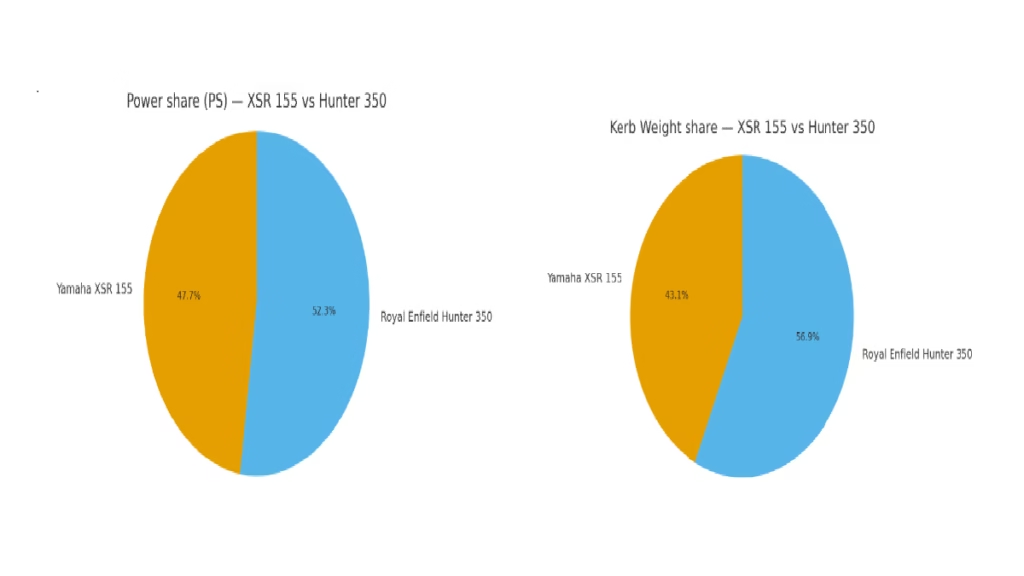
- Power share pie — Hunter 350 has slightly more peak power (≈20.2 PS) vs XSR 155 (≈18.4 PS) so the Hunter takes a small majority of the “power pie.” (See chart.)
- Kerb-weight pie — Hunter 350 is considerably heavier (181 kg vs 137 kg) and therefore dominates the weight pie; XSR’s lightness is a big advantage for nimble city riding.
The specifications show the biggest difference between these motorcycles: the Hunter 350 has much more torque, while the XSR 155 is dramatically lighter.
Current comparison data also shows that the XSR 155 produces about 18.1 bhp at 10,000 rpm and 14.2 Nm at 7,500 rpm, while the Hunter 350 produces around 20.2 hp at 6,100 rpm and 27 Nm at 4,000 rpm.
XSR 155 vs Hunter 350 Price
The Yamaha XSR 155 is positioned around the ₹1.50 lakh ex-showroom price point.
The Hunter 350 has a wider price range because Royal Enfield offers multiple variants. Current listings put the Hunter 350 starting around ₹1.38 lakh, while higher variants cost more.
| Bike | Approx. ex-showroom price |
|---|---|
| Yamaha XSR 155 | Around ₹1.50 lakh |
| Hunter 350 | Around ₹1.38 lakh onwards |
The important point is that the cheapest Hunter 350 and XSR 155 are not necessarily equivalent in equipment. The higher Hunter variants add features and hardware that make the comparison more meaningful.
Therefore, don’t choose the Hunter simply because its starting price is lower. Compare the exact variants before making a final decision.
Yamaha XSR 155 vs Hunter 350 Engine
This is where the two motorcycles become completely different.
The Yamaha XSR 155 gets a 155cc single-cylinder liquid-cooled engine. It produces around 18.1 bhp and 14.2 Nm and uses a six-speed gearbox.
The Hunter 350 gets a 349cc single-cylinder engine producing around 20.2 hp and 27 Nm with a five-speed gearbox.
At first glance, the Hunter appears to have the advantage because its engine is more than twice the displacement of the XSR.
But engine displacement does not tell the whole story.
The XSR 155 is designed to rev higher and produce its power at higher engine speeds. The Hunter 350 develops its torque much earlier, making it easier to ride without frequent gear changes.
Which engine feels stronger?
For low-speed riding, the Hunter 350 feels stronger because of its 27 Nm torque.
For high-rev performance and quick acceleration, the XSR 155 has an advantage because it is much lighter and has a six-speed gearbox.
This difference is important.
You should choose the Hunter 350 if you like relaxed acceleration with strong low-end response.
You should choose the XSR 155 if you enjoy revving the engine and want a more energetic riding experience.
XSR 155 vs Hunter 350 Performance
Performance is one area where the Yamaha XSR 155 can surprise buyers.
Despite having a much smaller engine, the XSR 155 is significantly lighter. Current testing recorded the XSR 155 accelerating from 0-100 km/h in around 11.66 seconds, compared with around 15.15 seconds for the Hunter 350.
| Performance test | XSR 155 | Hunter 350 |
|---|---|---|
| 0–60 km/h | 4.29 sec | 4.95 sec |
| 0–80 km/h | 7.02 sec | 8.75 sec |
| 0–100 km/h | 11.66 sec | 15.15 sec |
These are tested figures rather than guaranteed results for every rider.
The XSR’s biggest advantage is its very low kerb weight. At around 137 kg, it is roughly 40 kg lighter than the Hunter 350.
That weight difference makes a major difference during acceleration, cornering and city riding.
Hunter 350 vs XSR 155: Which Is Better for City Riding?
For daily city riding, both motorcycles have different strengths.
The Hunter 350 has strong low-end torque. This means you can ride at lower speeds without constantly shifting gears.
The XSR 155 is much lighter and easier to move through traffic. Its lighter weight can be particularly useful when making quick changes of direction or parking the motorcycle.
If your priority is easy low-speed riding and relaxed gear changes, the Hunter 350 is better.
If your priority is light handling and quick movement through traffic, the XSR 155 is better.
Winner for city riding: XSR 155 for lightweight handling
The Hunter is still an excellent city motorcycle, but the XSR’s 40-plus-kilogram weight advantage is difficult to ignore.
XSR 155 vs Hunter 350 Mileage
Fuel economy is another major difference.
The XSR 155 has a smaller 155cc engine and is considerably lighter. Available testing has recorded approximately 50.3 kmpl in city riding and 51.7 kmpl on the highway.
The Hunter 350 is less fuel-efficient because it has a larger engine. Available testing data is around 36 kmpl in the city and approximately 40 kmpl on the highway.
| Mileage | XSR 155 | Hunter 350 |
|---|---|---|
| City tested mileage | Around 50 kmpl | Around 36 kmpl |
| Highway tested mileage | Around 52 kmpl | Around 40 kmpl |
| Mileage advantage | XSR 155 | — |
Winner for mileage: Yamaha XSR 155
If you travel long distances every month and fuel economy is important, the XSR 155 has a clear advantage.
Actual mileage will vary depending on traffic, speed, rider weight, road conditions, tyre pressure and riding style.
XSR 155 vs Hunter 350 Weight
Weight is one of the most important specifications in this comparison.
The XSR 155 weighs approximately 137 kg, while the Hunter 350 is around 177–181 kg depending on the specification/source and variant.
That means the XSR 155 can be more than 40 kg lighter.
A lighter motorcycle offers several benefits:
- Easier parking
- Easier U-turns
- Easier handling in traffic
- Quicker direction changes
- Less effort when moving the bike manually
- Better power-to-weight ratio
Winner for weight: Yamaha XSR 155
This is one of the strongest reasons to consider the XSR 155.
XSR 155 vs Hunter 350 Seat Height
Seat height matters, especially for shorter riders.
The XSR 155 has a seat height of around 810 mm, while the Hunter 350 is around 790 mm.
| Motorcycle | Seat height |
|---|---|
| Yamaha XSR 155 | 810 mm |
| Hunter 350 | 790 mm |
The Hunter’s lower seat makes it easier for many riders to place their feet on the ground.
The XSR 155’s taller seat is not necessarily a disadvantage for taller riders, but shorter riders should take a test ride before buying.
XSR 155 vs Hunter 350 Brakes
Both motorcycles use disc brakes and dual-channel ABS.
The XSR 155 uses a 282 mm front disc and a 220 mm rear disc according to current comparison specifications. The Hunter uses a larger 300 mm front disc.
| Brake specification | XSR 155 | Hunter 350 |
|---|---|---|
| Front | 282 mm disc | 300 mm disc |
| Rear | 220 mm disc | Disc |
| ABS | Dual-channel | Dual-channel |
The Hunter has the larger front disc on paper, while the XSR combines its braking hardware with a much lower overall weight.
In real-world riding, both provide adequate braking for normal road use.
XSR 155 vs Hunter 350 Suspension
The XSR 155 has a sporty chassis setup with a USD front fork and rear monoshock.
The Hunter 350 uses a conventional telescopic front fork and twin rear shock absorbers.
| Suspension | XSR 155 | Hunter 350 |
|---|---|---|
| Front | USD fork | Telescopic fork |
| Rear | Monoshock | Twin shock absorbers |
The XSR’s setup contributes to its sporty character.
The Hunter’s setup is more traditional and suits its relaxed roadster character.
For riders who enjoy sharper handling, the XSR 155 is the more attractive package.
XSR 155 vs Hunter 350 Features
The Yamaha XSR 155 has a strong advantage in modern equipment.
It offers features such as a digital instrument cluster, smartphone connectivity, LED lighting and traction control. The Hunter 350 takes a simpler approach, although higher variants offer additional equipment such as Tripper navigation.
| Feature | XSR 155 | Hunter 350 |
|---|---|---|
| Digital instrument cluster | Yes | Variant dependent |
| Bluetooth connectivity | Yes | Variant dependent |
| Traction control | Yes | No |
| Dual-channel ABS | Yes | Yes |
| LED lighting | Yes | Variant dependent |
| USD front fork | Yes | No |
| Monoshock | Yes | No |
| Tripper navigation | No | Available on selected variants |
XSR 155 vs Hunter 350 Design
Design is subjective.
The XSR 155 has a modern-retro design with compact bodywork and sporty details. It looks more like a lightweight retro roadster with a performance-oriented character.
The Hunter 350 has a more traditional Royal Enfield appearance. Its round headlamp, fuel tank and compact roadster proportions give it a classic motorcycle identity.
If you want a modern and sporty retro motorcycle, choose the XSR 155.
If you prefer a classic roadster appearance, the Hunter 350 may appeal more to you.
Which Is Better for Highway Riding?
The XSR 155’s six-speed gearbox and lightweight construction make it a strong option for highway riding.
In independent testing, the XSR 155 reached 100 km/h significantly faster than the Hunter 350. Both can cruise at highway speeds, but the XSR has a more sporty character.
The Hunter 350 is better suited to riders who prefer relaxed cruising rather than aggressive acceleration.
Which Is More Comfortable?
Comfort depends on the rider.
The Hunter 350 has a lower seat and a relaxed riding character. Its strong low-end torque also means the rider does not need to rev the engine hard during everyday riding.
The XSR 155 has a taller 810 mm seat and a sportier riding character. Its low weight makes it easy to handle, but riders who prefer a relaxed riding position may prefer the Hunter.
XSR 155 vs Hunter 350: Maintenance
Maintenance cost should not be judged only by engine size.
The XSR 155 uses a modern liquid-cooled engine and more advanced electronics, while the Hunter 350 has a larger and simpler long-stroke engine.
Actual maintenance costs depend on service intervals, riding conditions, replacement parts and the service centre.
Before buying, check the latest official service schedule and spare-part prices in your city.
For long-term ownership, the more important question is not simply which bike is cheaper to service, but which motorcycle better matches your daily use.
Yamaha XSR 155 vs Hunter 350: Pros and Cons
Yamaha XSR 155 Pros
- Very lightweight
- Strong acceleration for its engine size
- Excellent fuel economy
- Six-speed gearbox
- Sporty handling
- Modern features
- Traction control
- Liquid-cooled engine
- Dual-channel ABS
Yamaha XSR 155 Cons
- Higher seat height
- Smaller fuel tank
- Lower torque than Hunter 350
- Sportier engine may require more gear changes at low speeds
- Not ideal for riders who prefer a relaxed riding character
Hunter 350 Pros
- Strong 27 Nm torque
- Relaxed engine character
- Lower seat height
- Larger fuel tank
- Classic roadster design
- Comfortable for everyday riding
- Strong low-speed performance
- Wide variant choice
Hunter 350 Cons
- Much heavier than XSR 155
- Lower fuel efficiency
- Less sporty acceleration
- Fewer modern electronic features
- Base and higher variants have different equipment
Yamaha XSR 155 vs Hunter 350: Who Should Buy Which?
Buy the Yamaha XSR 155 if:
You want a lightweight motorcycle that is easy to handle in city traffic.
You enjoy sporty acceleration and higher-revving engines.
You want better fuel economy.
You want modern features such as traction control and smartphone connectivity.
You frequently ride on highways and enjoy a more energetic riding style.
Buy the Hunter 350 if:
You want strong low-speed torque.
You prefer a relaxed riding experience.
You want a lower seat height.
You like the classic Royal Enfield design.
You regularly carry a pillion and want a comfortable roadster character.
You prefer a larger engine with strong mid-range performance.
Yamaha XSR 155 vs Hunter 350: Final Verdict
The Yamaha XSR 155 and Royal Enfield Hunter 350 are not direct mechanical equivalents, even though their prices and retro-roadster styling make them natural competitors.
The XSR 155 wins in several important areas: weight, acceleration, mileage, sporty handling, modern features and power-to-weight ratio. Independent testing also shows a significant acceleration advantage for the Yamaha.
The Hunter 350 wins where many everyday riders may value it most: torque, lower seat height, larger engine character and relaxed riding.
Overall winner: Yamaha XSR 155
For a rider who wants the better combination of performance, lightweight handling, fuel economy and technology, I would choose the Yamaha XSR 155.
However, the Hunter 350 is the better choice for riders who want a relaxed motorcycle with strong low-end torque and a lower seat.
So the final decision is simple:
Choose XSR 155 for performance, mileage and lightweight handling.
Choose Hunter 350 for torque, comfort and relaxed riding.
If your priority is overall performance and modern riding experience, XSR 155 gets the advantage in this comparison.