If you are planning to buy the Ather Rizta Z mainly for family use, one question is more important than the advertised range: how far can the scooter actually travel with two riders? The answer is different from the number printed on the specification sheet because real roads are not laboratory conditions. A pillion rider, traffic, speed, road slopes, tyre pressure, riding mode, weather and frequent acceleration can all change the energy consumption of an electric scooter.
The Ather Rizta Z is designed as a family-focused electric scooter, so carrying two people is one of its important use cases. Ather currently lists the Rizta Z with a claimed IDC range of up to 161 km, depending on the battery/variant configuration shown on its current specifications. The scooter uses a PMSM motor producing 4.3 kW peak power and 22 Nm of motor torque, with an 80 km/h claimed top speed.
But should you expect 161 km with two adults? No. IDC range should not be treated as your everyday two-rider range. For a family scooter, the more useful number is the distance you can realistically cover before you feel the need to recharge.
Ather Rizta Z Two-Rider Range: The Real Question
Suppose two adults are travelling together for a normal daily commute. The scooter has to move the combined weight of both riders instead of just one rider. That increases the total load, and the motor needs more energy to accelerate and maintain speed, particularly when starting from traffic signals or climbing an incline.
Ather itself explains that additional weight affects electric scooter range because greater mass requires more energy. The company also says that Rizta’s TrueRange system is intended to provide a more realistic indication of usable range, while SmartEco mode balances performance and efficiency.
For this reason, a sensible way to think about the Rizta Z is not simply “159 or 161 km range.” Instead, think about the conditions in which you normally ride.
For example, a two-rider commute through crowded city roads with moderate speeds can produce a very different result from a two-rider highway ride at 60–70 km/h.
What Range Can Two Riders Expect?
There is no single guaranteed real-world number because rider weight, speed, temperature and road conditions are different for every owner. However, if you are trying to estimate your own usage, a practical expectation is more useful than simply repeating the IDC figure.
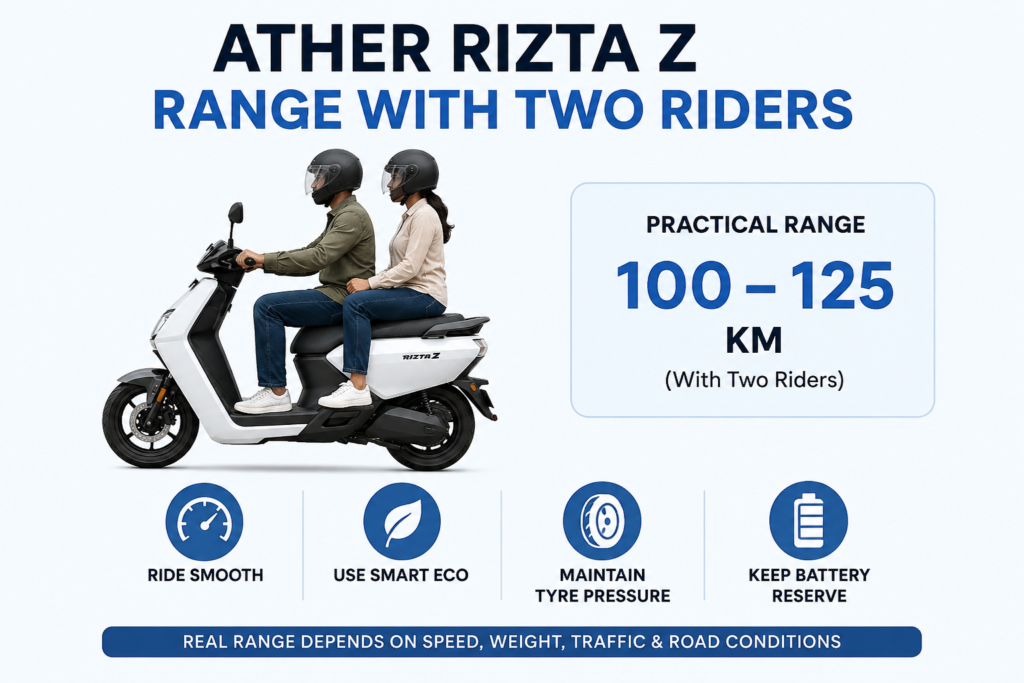
For a Rizta Z with the larger battery, a two-rider city commute could reasonably be planned around 100–125 km per full charge, depending heavily on riding conditions. In easy traffic, moderate speeds and efficient riding, you may get closer to the upper end. With heavier riders, frequent acceleration, slopes, high speeds or extensive stop-and-go traffic, the usable distance can fall.
This is an expected planning range, not an Ather-certified test result. Ather’s published specification gives the certified range, while actual performance can vary according to riding conditions.
That distinction is important because many electric scooter buyers make the mistake of converting the IDC figure directly into their daily range.
Why Two Riders Reduce Range
The biggest reason is simple physics: more weight requires more energy to move.
Imagine riding alone at 45 km/h on a flat road. The scooter only needs to accelerate and maintain the weight of one rider plus the scooter. Add another adult, and the total mass increases considerably.
The difference becomes particularly noticeable during:
- Frequent starts and stops
- Flyovers and steep roads
- Riding with a heavy pillion
- Fast acceleration from traffic signals
- Higher cruising speeds
- Riding against strong wind
- Low tyre pressure
The effect does not mean the Rizta suddenly becomes weak with a passenger. In fact, Ather specifically designed the Rizta around family use and says its motor’s torque helps it deal with additional load.
The important point is that performance and range are two different things. The scooter can carry two riders comfortably while still using more battery than it would with one rider.
Is the Ather Rizta Z Good for Two Adults?
For normal urban family use, the Rizta makes considerable sense because it was developed around this type of usage rather than being designed only as a sporty solo scooter.
Ather describes the Rizta as a family scooter and highlights features such as a large seat and 56-litre storage capacity.
The published specifications also show a 12-inch front and rear wheel setup, tubeless tyres and a 15-degree gradeability claim.
For two adults, seat comfort and stability can actually matter more than having an extremely high top speed. A family scooter is generally expected to handle school drops, office commuting, shopping and short trips with a passenger.
Two Riders in City Traffic
City traffic is where the Rizta Z can make the most sense.
If you and a passenger travel at moderate speeds and avoid unnecessary hard acceleration, the scooter can be used efficiently. Stop-and-go traffic does consume energy, but riding at sensible speeds can help keep consumption under control.
For example, imagine a daily journey of 40 km total:
20 km going to work + 20 km returning home = 40 km/day.
If your two-rider real-world range is around 110 km, the theoretical distance gives you roughly two and a half days of similar travel before a recharge becomes necessary.
However, most owners should not plan their commute by taking the battery down to zero. Keeping some reserve is useful because unexpected traffic, detours, rain or an additional trip can increase consumption.
What Happens on a Highway?
The answer changes when you leave the city.
Higher speed generally increases energy consumption because aerodynamic resistance rises significantly with speed. A scooter travelling continuously at higher speeds can therefore use considerably more battery than one moving through a slower urban environment.
This is why someone may see a much lower range during a long highway ride than during a moderate-speed city commute.
With two riders, the difference can become more noticeable. If you regularly travel long distances with a passenger at relatively high speeds, you should use a conservative range estimate rather than depending on the maximum IDC figure.
SmartEco Mode Can Help
The Rizta includes SmartEco mode, and Ather says this mode dynamically balances power and efficiency. Ather’s current information lists SmartEco among the Rizta’s riding modes.
For two-rider commuting, SmartEco can be a useful choice when your priority is range rather than maximum acceleration.
This does not mean SmartEco will magically add a fixed number of kilometres to every ride. Instead, it can help manage power delivery according to riding conditions.
If you are carrying a passenger and your destination is still far away, smooth acceleration and moderate speeds are generally more useful than repeatedly using maximum throttle.
Does Rider Weight Matter?
Yes, but there is no universal percentage that can be applied to every situation.
Consider two examples.
Example 1:
A 60 kg rider + 50 kg passenger.
Example 2:
A 90 kg rider + 80 kg passenger.
The second combination puts substantially more total mass on the scooter. If both scooters travel at exactly the same speed, on the same road and in the same weather, the heavier combination will generally require more energy, particularly during acceleration and climbing.
This is why one owner may report excellent range while another owner reports significantly lower figures.
Neither person necessarily has a faulty scooter.
Their riding conditions may simply be different.
Tyre Pressure Is an Easy Range Factor to Ignore
Tyre pressure is something many electric scooter owners overlook.
Under-inflated tyres can increase rolling resistance. That means the motor has to work harder to move the scooter.
When carrying two people regularly, maintaining the manufacturer’s recommended tyre pressure becomes even more important.
Do not increase tyre pressure simply because you are carrying a passenger. Instead, check the recommended pressure in the owner’s documentation and keep the tyres properly inflated.
It is a simple maintenance habit that can help with efficiency, handling and tyre life.
Does Battery Age Reduce Range?
Yes.
A battery does not remain exactly like new forever. Battery capacity can decline gradually with age and usage. Ather’s corporate disclosures also acknowledge that the range of electric two-wheelers can decrease over time as battery packs deteriorate.
This means a brand-new Rizta and a heavily used Rizta may not deliver exactly the same distance under identical conditions.
For someone buying the scooter for several years of family use, this is another reason not to calculate ownership around the absolute maximum advertised range.
A Better Way to Calculate Your Own Range
The easiest method is to stop guessing.
After charging your Rizta Z fully, reset your trip meter. Ride normally with the same type of passenger and route that you use every day.
Record:
Starting battery: 100%
Distance travelled: 40 km
Remaining battery: 65%
Now you have real information about your own scooter.
Repeat the test several times under similar conditions. If your results are consistent, you will develop a much better understanding of your personal two-rider range than any generic internet number can provide.
This is particularly useful because your actual range depends on your city, traffic, riding style, rider weight and weather.
A Simple Two-Rider Range Example
Let’s say your Rizta Z gives you approximately 115 km in your normal two-rider usage.
Instead of saying:
“My scooter has 115 km range.”
It is better to divide your usage into a safety zone.
If your daily journey is 30 km, the scooter should provide plenty of usable distance.
If your daily journey is 60 km, you need to consider where and when you can charge.
If your daily journey is 100 km, depending on conditions, you may be operating with a much smaller reserve.
And if you regularly need 120–130 km of two-rider travel without charging, choosing a larger-battery configuration and planning charging access becomes much more important.
What About Two Riders on Hills?
Hilly roads are a different challenge.
The motor must work against gravity while climbing. The heavier the combined load, the more energy is required.
The Rizta’s published specification lists a gradeability figure of 15 degrees, but gradeability and range are different measurements. A scooter may be capable of climbing a particular slope, but repeated climbs will consume more energy than riding on flat roads.
Therefore, if you live in a hilly area and normally carry a passenger, do not use the flat-city range as your planning number.
What About Rain and Cold Weather?
Weather can also affect real-world electric vehicle performance.
Rain can increase rolling resistance and may change traffic conditions. Riders may also accelerate and brake differently on wet roads.
Temperature can influence battery performance as well.
For Indian city users, extreme cold may be less important than in colder countries, but hot weather, heavy rain and changing road conditions can still affect your actual riding experience.
Again, the important lesson is simple: range is a moving number, not a fixed number.
How Far Should You Safely Plan to Ride?
If you own a larger-battery Rizta Z and normally ride with two adults, I would avoid planning an important trip around the maximum advertised IDC range.
For everyday family use, planning around your observed real-world range with a reasonable battery reserve is much safer.
For example, if your scooter consistently manages around 110–120 km in your normal two-rider usage, do not suddenly plan a 115 km journey through unfamiliar roads without considering charging options.
A comfortable EV commute is not just about reaching the destination. It is also about having enough battery left for unexpected situations.
Can Two Riders Affect Acceleration?
Yes, particularly from a standstill.
A heavier combined load requires more energy to accelerate. You may notice that the scooter feels different with one rider compared with two.
However, the Rizta’s motor produces 22 Nm of peak torque, and Ather says the motor and transmission are designed to provide strong pulling capability under load.
For everyday family riding, smooth acceleration is generally preferable. There is little advantage in repeatedly demanding maximum acceleration if your priority is range.
The Biggest Mistake: Comparing IDC Range With Real Range
This is probably the most important part of the entire article.
IDC range is a test figure.
Your daily journey is real life.
In the real world, you may have:
- Two riders
- Traffic signals
- Speed breakers
- Flyovers
- Uneven roads
- Frequent acceleration
- Air resistance
- Different temperatures
- Tyre pressure changes
- Extra luggage
All of these can change energy consumption.
Ather’s own specifications distinguish its declared IDC range from TrueRange and state that actual performance can vary with riding conditions and driving patterns.
Therefore, don’t judge the Rizta Z only by its maximum range number.
Final Verdict: Ather Rizta Z With Two Riders
So, what can you actually expect from the Ather Rizta Z with two riders?
If you have the larger-battery Rizta Z, the advertised IDC figure is far higher than what most people should expect in every real-world two-rider situation. For planning purposes, a range around 100–125 km can be a reasonable practical target under many normal two-rider conditions, but your actual result can be higher or lower depending on speed, combined rider weight, traffic, road gradient, weather and riding style.
The most important point is that the Rizta was designed with family usage in mind. Ather specifically discusses passenger/load use and explains how SmartEco and TrueRange are intended to help balance efficiency and real-world riding.
If your daily two-rider trip is 30–50 km, the Rizta Z should be a much easier range proposition than if you regularly need 100+ km without charging.
My practical advice: don’t buy the Rizta Z because the brochure says 159/161 km. Buy it if your actual daily requirement comfortably fits within the real-world range you can expect with your normal passenger, route and speed.
That is the number that matters.
Quick Answer
Ather Rizta Z IDC range: up to about 161 km depending on the current variant/configuration.
Practical two-rider planning range: roughly 100–125 km for the larger-battery version in many normal conditions, but this is an estimate rather than an official Ather test figure.
Best way to maximise range: use a sensible riding mode such as SmartEco, maintain correct tyre pressure, avoid unnecessary hard acceleration and keep a battery reserve.
Best use case: daily family commuting, office travel, shopping and regular two-person city riding.
Bottom line: The Ather Rizta Z can comfortably make sense as a two-rider family scooter, but don’t confuse its laboratory-certified range with the distance you will always achieve on Indian roads. Your own two-rider riding pattern is the most reliable range test.