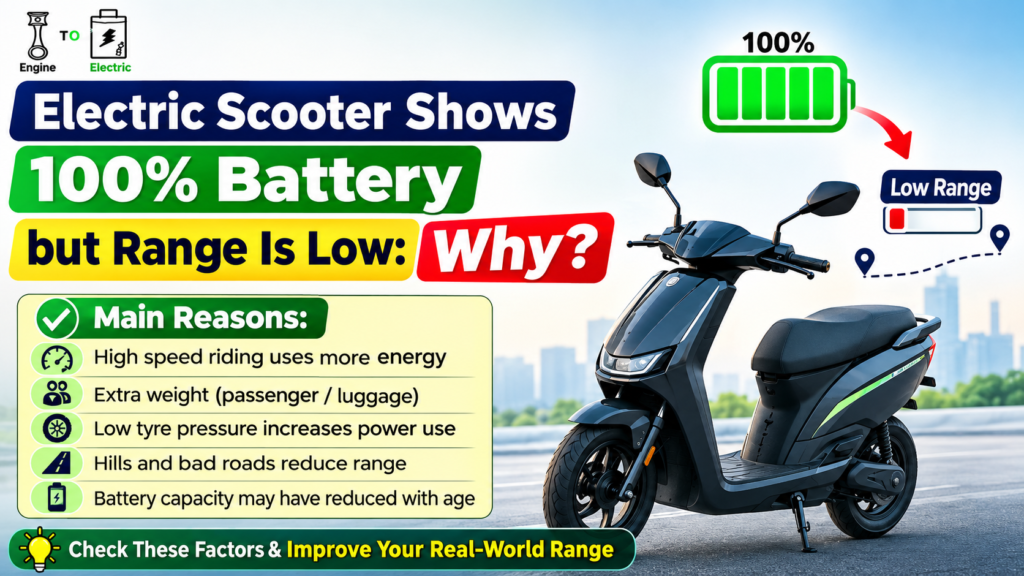
Seeing 100% battery but getting much less range than expected can be confusing. However, a full battery does not always mean the scooter will deliver its claimed range. Range depends on riding conditions, battery health, speed, temperature, tyre pressure, and several other factors.
1. The Battery Is Full, But Its Capacity May Have Reduced
A battery showing 100% means the battery is fully charged according to the scooter’s battery-management system. It does not necessarily mean the battery still has its original capacity.
As a battery gets older, its usable capacity can gradually decrease. For example, a scooter that originally travelled 100 km under certain test conditions may provide considerably less range after years of use.
The percentage tells you the current charge level, not the original battery capacity.
2. High-Speed Riding Reduces Range
Speed has a major effect on electric scooter efficiency. Riding continuously at high speed requires more energy because air resistance increases rapidly with speed.
If you normally ride at 70–80 km/h instead of 40–50 km/h, your range can drop noticeably even when the battery starts at 100%.
For better range, maintain a steady and moderate speed whenever possible.
3. Frequent Acceleration Uses More Energy
Repeated hard acceleration consumes more battery power than smooth acceleration. Stop-and-go traffic, quick overtaking and aggressive riding can therefore reduce the distance you get from a full charge.
Smooth acceleration and steady riding are among the easiest ways to improve real-world range.
4. Tyre Pressure May Be Too Low
Under-inflated tyres create more rolling resistance. The motor then needs more energy to move the scooter.
Check your tyre pressure regularly and keep it close to the manufacturer’s recommended level. Do not simply use the maximum pressure printed on the tyre unless the scooter manufacturer recommends it.
5. Two Riders Or Heavy Loads Reduce Range
Carrying a passenger, luggage or other additional weight makes the motor work harder, especially during acceleration and on slopes.
If your scooter normally gives good range with one rider but much less with two people, this can be completely normal.
6. Hills and Bad Roads Consume More Energy
Uphill riding requires significantly more energy than riding on level roads. Rough roads, frequent braking and repeated acceleration can also increase consumption.
A range figure achieved on a flat test route cannot be expected in every real-world riding condition.
7. Cold Or Very Hot Weather Can Affect Range
Battery performance can change with temperature. Extremely hot or cold conditions may reduce usable energy or temporarily affect the scooter’s range calculation.
After returning to normal temperatures, the displayed range may improve.
8. The Range Display May Be Only An Estimate
Many electric scooters calculate the remaining range using recent riding patterns. If you recently rode aggressively, the estimated range may fall even though the battery still shows 100%.
Likewise, after several kilometres of gentle riding, the estimated range may increase.
Check All Things
Start with tyre pressure, riding speed, passenger/load, road conditions and recent riding style. Then check whether the battery is ageing or whether the scooter’s range calculation needs time to adjust.
If the scooter suddenly loses a large amount of range despite normal riding conditions, check the scooter through an authorised service centre. A battery, motor, controller or software-related issue could sometimes be responsible.
In most cases, 100% battery with low range does not mean the battery is immediately faulty. Real-world range is affected by many factors, and the displayed percentage should be considered a charge indicator rather than a guarantee of distance.