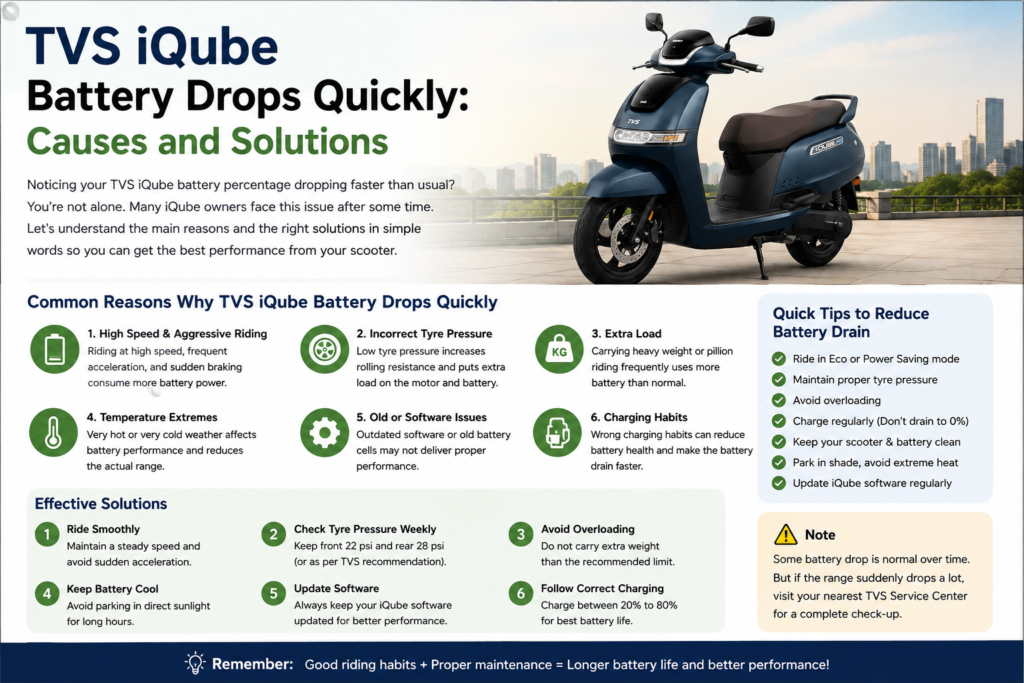
If your TVS iQube battery drops faster than usual, you may immediately think that the battery has become weak. However, a fast battery percentage drop does not always mean that the battery itself is damaged.
Riding speed, acceleration, tyre pressure, rider weight, road conditions, temperature, riding mode, battery age and even the way the scooter is charged can affect energy consumption.
The first thing to understand is the difference between battery percentage dropping quickly and range becoming lower. They can be related, but they are not exactly the same problem.
For example, if your iQube normally gives you 80 km of useful riding and suddenly gives only 50 km, something may have changed. But if the battery percentage falls quickly during a particular high-speed ride, heavy traffic or uphill journey, the battery may simply be supplying more energy because the scooter is working harder.
TVS says the iQube uses a battery-management system and that its battery is continuously monitored. The company also says that under-inflated tyres increase rolling resistance and consume more energy.
This guide explains the most common reasons for a TVS iQube battery dropping quickly and what you can safely check before visiting a service centre.
Why Does My TVS iQube Battery Drop Quickly?
The most common reasons include:
- High-speed riding
- Frequent hard acceleration
- Heavy traffic and repeated stop-and-go riding
- Low tyre pressure
- Carrying a heavy load
- Riding with two people
- Uphill roads
- Strong headwind
- Very hot or cold conditions
- Battery ageing
- Incorrect charging practices
- Software or vehicle-system issues
- A battery or electrical-system fault
Not every fast percentage drop means the battery is defective.
The best way to identify the problem is to compare your scooter under similar riding conditions.
1. High-Speed Riding Can Drain the Battery Faster
One of the simplest reasons for a quick battery drop is speed.
An electric scooter requires more energy as speed increases. If you normally ride gently but recently started riding at higher speeds, you may notice the battery percentage falling faster.
For example, imagine two similar trips:
Trip A: Smooth riding at moderate speed with gentle acceleration.
Trip B: High-speed riding with frequent acceleration and braking.
Even if both trips cover the same distance, the energy consumed can be different.
This is normal for electric vehicles.
Solution
Try riding at a steady speed for a few days.
Avoid unnecessary rapid acceleration and compare:
- Distance travelled
- Battery percentage used
- Riding mode
- Average speed
- Road conditions
This gives you a much better idea of whether the scooter’s efficiency has actually changed.
2. Hard Acceleration Can Increase Battery Consumption
Electric motors produce strong instant torque.
That is one of the biggest advantages of an electric scooter.
But repeatedly using strong acceleration also requires more electrical energy.
If you frequently:
- Accelerate hard from a standstill
- Overtake aggressively
- Accelerate after every traffic signal
- Rapidly increase speed
the battery can fall faster.
Solution
Try smoother acceleration.
You don’t need to accelerate extremely slowly. The goal is to avoid unnecessary bursts of power.
A smooth riding style can make your energy consumption more consistent.
3. Low Tyre Pressure Can Cause Faster Battery Drain
This is one of the easiest things to check.
TVS specifically states that under-inflated tyres increase rolling resistance and consume more energy.
When tyre pressure is too low, the motor has to work harder to move the scooter.
That extra resistance can reduce efficiency.
What should you do?
Check tyre pressure regularly.
The correct pressure depends on the exact iQube variant and tyre specification, so use the pressure recommended in your owner’s manual rather than copying a number from another iQube model.
For example, TVS’s current owner documentation for one 3.5 kWh iQube specification lists:
- Front: 24 psi
- Rear, solo: 32 psi
- Rear, dual: 36 psi
But do not assume these figures apply to every iQube variant. Check your specific manual.
Important
Don’t overinflate the tyres either.
Too much or too little pressure can affect handling and efficiency.
4. Carrying More Weight Uses More Battery
The heavier the total load, the more work the motor has to do.
Total load includes:
- Rider
- Passenger
- Luggage
- Accessories
If you normally ride alone and recently started carrying a passenger or heavy luggage, your battery consumption may increase.
This becomes particularly noticeable when travelling uphill or accelerating repeatedly.
Solution
Avoid carrying unnecessary weight.
If you regularly ride with a passenger, compare your range with solo riding rather than expecting the same efficiency.
5. Riding With a Passenger Can Reduce Range
The TVS iQube is capable of carrying a load within its specified limits, but additional weight naturally affects energy consumption.
A two-person ride requires more power than a solo ride, particularly:
- During acceleration
- On slopes
- In heavy traffic
- During repeated stops
Therefore, don’t compare a solo trip with a two-person trip and conclude immediately that the battery is faulty.
Simple test
Ride the same route:
Day 1: Solo
Day 2: With passenger
Keep speed and riding style as similar as possible.
The difference can help you understand the effect of additional weight.
6. Hills Can Make the Battery Percentage Fall Quickly
Climbing requires energy.
When an electric scooter travels uphill, the motor must overcome gravity in addition to rolling resistance and air resistance.
Therefore, the battery can fall noticeably faster on:
- Flyovers
- Hilly roads
- Steep ramps
- Long climbs
TVS lists the iQube’s gradeability at 10 degrees on its current FAQ.
That does not mean every hill will consume the same amount of battery.
The actual consumption depends on:
- Gradient
- Rider weight
- Speed
- Distance
- Starting battery level
- Road surface
Solution
If your regular route contains hills, compare your energy consumption with a flatter route before assuming there is a battery problem.
7. Stop-and-Go Traffic Can Increase Energy Consumption
Many people assume that slow traffic automatically gives better range.
Not always.
In heavy traffic, the scooter may repeatedly:
Start → accelerate → brake → stop → start again.
Every acceleration requires energy.
Frequent stop-and-go riding can therefore be less efficient than smooth travel at a steady speed.
Solution
Where safe and legal, maintain a smooth pace.
Avoid unnecessary acceleration between closely spaced traffic signals.
8. Weather and Temperature Can Affect Battery Performance
Temperature can affect battery performance.
TVS explains that the iQube’s battery-management system monitors battery conditions and can limit performance or pause charging when conditions are outside the safe operating region.
This means temperature should be considered when investigating a sudden range change.
Very hot conditions can also make riders use different riding patterns, such as more aggressive acceleration or additional loads.
In hot weather
Try to:
- Park in a shaded location where possible
- Avoid exposing the scooter unnecessarily to intense heat
- Allow the vehicle to cool if it has become very hot
- Follow TVS charging instructions
TVS’s warranty documentation specifically warns against battery exposure to direct sunlight or excessive heat.
9. Battery Age Can Reduce Available Range
Lithium-ion batteries naturally age.
As a battery accumulates charging cycles and time, its available capacity can gradually decrease.
That does not automatically mean the battery has failed.
A two- or three-year-old scooter may not deliver exactly the same usable range as it did when new.
The important question is:
How much has the range changed?
A gradual reduction can be normal ageing.
A sudden and large reduction deserves investigation.
10. A Sudden Range Drop Is More Important Than a Gradual Drop
This is an important distinction.
Gradual change
For example:
New scooter → 100% to 0% gives a certain range.
After years of use → range slowly becomes lower.
This can be related to normal battery ageing and other changes in the vehicle.
Sudden change
For example:
Last week → normal range
This week → dramatically lower range
A sudden change can indicate something that needs checking.
Possible causes can include:
- Tyre pressure
- Brake drag
- Software behaviour
- Battery-management issue
- Charging problem
- Battery-cell imbalance
- Electrical-system fault
If the change is significant and remains after basic checks, contact an authorised TVS service centre.
11. Brake Drag Can Reduce Range
A brake that does not release correctly can create additional resistance.
The scooter may still move normally, but the motor has to work harder.
This can reduce efficiency.
Signs of possible brake drag
You may notice:
- Scooter feels unusually heavy
- Reduced coasting
- Wheel becoming unusually hot
- Burning smell
- Lower range without another obvious reason
Do not attempt complicated brake repairs yourself.
If you suspect a brake problem, have it inspected by a qualified technician.
12. Riding Against Strong Wind Can Reduce Range
Air resistance becomes increasingly important as speed increases.
A strong headwind means the scooter has to push against more air.
Therefore, two trips covering the same distance can use different amounts of energy.
For example:
Outbound: Strong headwind
Return: Tailwind
The battery consumption may not be identical.
This is normal.
13. Battery Percentage Is Not the Same as Distance
The battery display tells you about the estimated state of charge, while the distance-to-empty estimate is an estimate of how far you may be able to travel.
TVS says the iQube provides DTE, or distance-to-empty, information to indicate the kilometres that can be covered with the remaining state of charge.
The estimate can change according to recent riding conditions.
For example, after riding aggressively, the estimated remaining range may fall.
After riding more efficiently, the estimate may behave differently.
Therefore, don’t judge battery health from one short ride.
14. The Range Estimate Can Change During a Ride
Suppose your scooter shows a certain remaining range when you start.
After several kilometres of high-speed riding, the estimate may decrease faster than expected.
That doesn’t necessarily mean the battery physically lost an abnormal amount of energy.
The system is continuously estimating remaining usable energy and expected consumption.
Recent riding conditions influence what the scooter predicts.
Better method
Track actual distance travelled over several rides.
Record:
- Starting battery %
- Ending battery %
- Distance travelled
- Average riding conditions
- Riding mode
- Number of riders
This is much more useful than watching the percentage every few seconds.
15. Charging Problems Can Affect Battery Performance
The way an EV is charged matters.
TVS recommends using the manufacturer-recommended charger. Its FAQ specifically advises using a TVS-recommended charger to maintain the warranty status.
Do not use an unknown or incompatible charger simply because its connector appears to fit.
The charger and battery-management system are designed to work together.
Check:
- Is the original/recommended charger being used?
- Does charging start normally?
- Does charging stop unexpectedly?
- Is the charger unusually hot?
- Is there any visible cable damage?
- Is the electrical outlet stable?
If you notice abnormal charging behaviour, get the scooter checked.
16. Don’t Leave the Battery Fully Discharged for a Long Time
This is particularly important.
TVS warranty documentation warns that leaving the battery fully discharged for a long time can be excluded from warranty coverage. One current iQube manual specifies that vehicles should be charged to at least 30% state of charge once every 15 days.
So if your scooter is not being used for an extended period, follow the storage instructions in your specific owner’s manual.
Do not simply leave an EV at 0% for weeks.
17. Battery Management System Problems
The iQube uses electronic battery management and monitoring.
TVS says the battery is continuously monitored along with other controllers.
If the system detects conditions outside its safe operating range, it can take protective measures.
This means that unusual battery behaviour should not automatically be diagnosed as a damaged battery.
A service technician can check the vehicle’s diagnostic information and battery condition.
18. Software Can Also Be Worth Checking
Modern electric scooters rely heavily on software.
The dashboard, battery-management system, motor controller and connected features all work together.
If your iQube suddenly behaves differently after an update or develops an unusual display or range-estimation issue, mention the change to the service centre.
Do not assume that the battery itself is defective without diagnosis.
19. Battery Cell Imbalance Can Be a Technical Cause
A battery pack contains multiple cells or cell groups.
The battery-management system monitors them.
If there is a significant imbalance or a fault within the battery pack, usable capacity and performance can be affected.
This is not something an owner should try to repair by opening the battery pack.
TVS specifically states that the iQube batteries are non-removable and warns that tampering with batteries and connectors can affect warranty claims.
Solution
If you suspect a battery-pack problem, take the scooter to an authorised TVS service centre.
20. Never Open the TVS iQube Battery Yourself
This is one of the most important safety points.
Do not:
- Open the battery casing
- Disconnect battery connectors
- Attempt cell replacement
- Swap batteries between scooters
- Perform DIY electrical testing on the high-voltage system
TVS states that tampering with the batteries and connectors can affect warranty claims.
Electric vehicle batteries can contain significant stored energy.
A qualified technician should handle battery-system faults.
How to Check Whether Your TVS iQube Battery Is Actually Weak
Don’t immediately visit a service centre saying:
“My battery is bad.”
First collect some basic information.
Step 1: Fully charge using the recommended charger
Charge the scooter according to TVS instructions.
Step 2: Note the battery percentage
Record the starting percentage.
Step 3: Reset your trip measurement
If your scooter provides a trip-distance function, note the starting value.
Step 4: Ride normally
Don’t deliberately ride aggressively just to test the battery.
Step 5: Record the distance
Write down how many kilometres you travelled.
Step 6: Record the ending percentage
Compare the battery percentage with the distance travelled.
Step 7: Repeat
Do this over several comparable rides.
One ride is not enough to determine battery health.
Example of a Simple Range Test
Suppose you start with:
Battery: 80%
After a normal trip:
Battery: 60%
Distance: 20 km
You used approximately 20 percentage points for 20 km under those particular conditions.
Now repeat the test on a similar route.
If the results are consistently similar, the battery behaviour may be normal.
If the scooter suddenly starts using dramatically more energy for the same route and riding style, further investigation is sensible.
Keep a Simple Battery Log
A battery log can help identify patterns.
| Date | Starting Battery | Ending Battery | Distance | Riding Condition |
|---|---|---|---|---|
| Day 1 | 100% | 75% | 20 km | Normal |
| Day 2 | 100% | 77% | 20 km | Smooth |
| Day 3 | 100% | 68% | 20 km | Heavy traffic |
| Day 4 | 100% | 70% | 20 km | Two riders |
This makes it easier to understand why consumption changes.
TVS iQube Battery Drops Quickly After 50%
Many owners become concerned when the battery percentage starts falling faster after reaching a certain level.
Don’t immediately assume this means the battery is defective.
Battery percentage is a system estimate, and usable energy is not always experienced as a perfectly linear relationship between percentage and kilometres.
Instead of focusing only on whether:
1% = exactly X kilometres
look at the overall range across multiple rides.
If the scooter consistently shows abnormal behaviour, have it checked.
TVS iQube Battery Drops Quickly Below 30%
If the battery seems to fall rapidly at a lower state of charge, monitor the behaviour carefully.
A small difference between the displayed percentage and expected range does not automatically mean battery damage.
However, if the scooter:
- Suddenly loses a large percentage
- Shows unexpected warnings
- Loses power
- Stops unexpectedly
- Refuses to charge
- Shows unusual battery behaviour
you should stop treating it as a simple range issue.
Contact an authorised TVS service centre.
TVS iQube Battery Percentage Jumps
Another issue that can concern owners is a sudden percentage change.
For example:
55% → 48%
without travelling a significant distance.
There can be several reasons for unusual display behaviour, and it is difficult to diagnose the cause without vehicle data.
Don’t open the battery or attempt to reset internal components yourself.
Record when the problem happens and show the information to the service technician.
What If the Battery Drops Quickly Only in Summer?
Hot weather can affect EV operation.
TVS says its battery-management system can take protective measures under temperature conditions outside its safe operating region.
If your scooter performs differently during very hot weather, compare it with similar rides in moderate temperatures.
Also avoid leaving the scooter exposed to direct sunlight for long periods.
TVS warranty documentation specifically lists exposure to direct sunlight or excessive heat as a battery-related warranty limitation.
What If the Battery Drops Quickly in Winter?
Cold temperatures can also influence battery performance.
The exact effect depends on the battery chemistry, temperature and operating conditions.
If you notice lower range during unusually cold weather, compare the scooter again when temperatures return to normal.
A temporary change does not necessarily mean permanent battery damage.
Does Tyre Pressure Really Make a Difference?
Yes.
TVS itself explains that under-inflated tyres increase rolling resistance and therefore consume more energy.
This is why tyre pressure should be one of the first things you check.
It is simple, inexpensive and does not require opening the scooter.
Check pressure regularly and use the specification for your exact iQube model.
Does Eco Mode Increase Range?
A more conservative riding mode can help reduce energy consumption if it limits acceleration or speed.
However, the exact result depends on how you ride.
A rider using a higher-performance mode gently may sometimes consume less energy than someone constantly accelerating hard in an economy mode.
The important factor is actual riding behaviour.
Should I Always Ride Slowly to Save the Battery?
No.
You don’t need to ride dangerously slowly.
The goal is smooth and appropriate riding, not simply the lowest possible speed.
Avoid:
- Unnecessary hard acceleration
- Excessive speed
- Aggressive starts
- Unnecessary braking and acceleration cycles
A steady riding style is generally a better strategy.
Can a Heavy Rider Get Less Range?
Yes.
A heavier total load means the motor has more work to do.
This is especially noticeable during:
- Acceleration
- Hill climbing
- Starting from a stop
- Riding against wind
That is why two people can get different range from the same iQube.
Can Pillion Riding Reduce iQube Range?
Yes.
Additional passenger weight can increase energy consumption.
This doesn’t necessarily indicate a battery problem.
If your normal usage is solo riding and you suddenly start carrying a passenger every day, expect consumption to change.
Can Rain Reduce Range?
Rain itself is not necessarily a direct battery-drain cause.
However, wet roads can increase rolling resistance, reduce tyre grip and change riding conditions.
Riders may also accelerate and brake differently.
The more important concern during heavy rain is safety and water exposure.
Follow TVS guidance for water use and do not expose electrical components to inappropriate conditions.
What If My iQube Range Was Good When New?
If your iQube was performing normally when new and the range has gradually decreased over a long period, battery ageing and general vehicle condition are possible contributors.
If the change happened suddenly, investigate other factors first.
A useful checklist is:
Tyre pressure → riding style → load → route → temperature → charging → software/system behaviour → service diagnosis
When Should You Visit a TVS Service Centre?
You should arrange a professional inspection if:
- Range suddenly becomes much lower
- Battery percentage behaves unusually
- Scooter loses power
- Charging stops unexpectedly
- Battery warning appears
- Charging takes much longer than expected
- Scooter becomes unusually hot
- There is an unusual smell
- Battery casing appears damaged
- The scooter repeatedly refuses to charge
- Performance changes without an obvious reason
Do not wait for a complete failure if the symptoms are severe.
Is TVS iQube Battery Covered Under Warranty?
TVS’s current warranty information states that the TVS iQube vehicle and battery have a 3-year/50,000 km warranty, whichever occurs earlier, subject to the applicable terms and conditions.
However, warranty coverage is not the same as a guarantee that every reduction in range will result in a free battery replacement.
TVS’s warranty documents contain exclusions for issues associated with misuse, neglect, inappropriate charging, prolonged full discharge and other conditions.
Therefore, if you believe your battery has a manufacturing defect, take the scooter to an authorised service centre and request a proper battery-system diagnosis.
What About TVS iQube Extended Battery Warranty?
TVS currently offers battery extended-warranty options for eligible iQube models and purchase periods.
Its official FAQ lists different pricing and eligibility depending on battery size, model, vehicle age and kilometres.
TVS also offers a Battery as a Service program for eligible configurations, with the company advertising up to 5 years/70,000 km battery warranty depending on the selected subscription tenure.
Because these programs can change, owners should check the current TVS terms rather than relying on an old article or social-media post.
10 Quick Things to Check When iQube Battery Drops Quickly
Before assuming the battery is damaged, check:
1. Tyre pressure
Low pressure increases rolling resistance.
2. Riding speed
Higher speed generally uses more energy.
3. Acceleration
Aggressive acceleration can increase consumption.
4. Passenger
Extra weight increases the work required.
5. Luggage
Remove unnecessary weight.
6. Route
Hills and heavy traffic can increase consumption.
7. Weather
Extreme temperatures can affect EV operation.
8. Charger
Use the TVS-recommended charger.
9. Battery storage
Don’t leave the battery fully discharged for an extended period.
10. Service diagnosis
If the change is sudden or severe, get the scooter checked.
Things You Should NOT Do
When your iQube battery is draining quickly, avoid these mistakes.
Don’t open the battery
The battery system should be serviced by qualified personnel.
Don’t use an unknown charger
TVS recommends the manufacturer-recommended charger.
Don’t intentionally drain the battery to 0% repeatedly
There is no need to repeatedly perform extreme discharge cycles to “test” the battery.
Don’t leave the scooter fully discharged for weeks
TVS’s warranty documentation specifically warns against prolonged fully discharged conditions.
Don’t compare two different iQube variants without checking specifications
Different battery sizes and configurations can provide different results.
Don’t judge battery health from one ride
Use several comparable rides.
TVS iQube Battery Drops Quickly: Simple Troubleshooting Flow
You can follow this simple process:
Battery dropping quickly
↓
Check tyre pressure
↓
Check riding speed and acceleration
↓
Check passenger/luggage
↓
Check hills and traffic
↓
Check temperature and parking conditions
↓
Check charging behaviour
↓
Repeat the range test
↓
Still significantly lower?
↓
Visit authorised TVS service centre
This approach is better than immediately assuming that the battery needs replacement.
Frequently Asked Questions
Why is my TVS iQube battery draining so fast?
High speed, aggressive acceleration, low tyre pressure, additional weight, hills, traffic, weather and battery ageing can all affect energy consumption. A sudden major change should be professionally diagnosed.
Does low tyre pressure reduce TVS iQube range?
Yes. TVS specifically states that under-inflated tyres increase rolling resistance and consume more energy.
Can riding fast drain the iQube battery faster?
Yes. Higher speeds generally require more energy.
Does carrying a passenger reduce range?
It can. The motor has to move a greater total load.
Can battery age cause lower range?
Yes. Lithium-ion batteries naturally lose some capacity as they age.
Should I replace my battery if the range decreases?
Not automatically. First identify whether the change is caused by riding conditions, tyres, load, temperature, charging or another vehicle issue. A service centre can diagnose the battery before replacement is considered.
Can I remove the iQube battery myself?
No. TVS says the iQube battery is non-removable and warns against battery/connector tampering.
Can I use another charger?
Use the charger recommended by TVS. The company specifically advises using a TVS-recommended charger.
Does leaving the iQube at 0% damage the battery?
Leaving it fully discharged for a long time can be harmful and is specifically addressed as a warranty limitation in TVS documentation.
Why does my iQube lose more battery on hills?
The motor needs additional energy to overcome gravity while climbing.
Why does my battery drain faster with two riders?
The additional weight requires more energy, especially during acceleration and climbing.
Can hot weather affect iQube battery performance?
Temperature can affect battery operation. TVS states that its battery-management system monitors conditions and can limit performance or pause charging when conditions are outside its safe operating region.
How can I improve my TVS iQube range?
Maintain the correct tyre pressure, ride smoothly, avoid unnecessary weight, use the appropriate riding mode, keep the vehicle properly maintained and follow TVS charging/storage recommendations.
Final Verdict
A TVS iQube battery dropping quickly does not automatically mean that the battery is damaged.
Start with the simple things.
Check your tyre pressure. Review your speed and acceleration. Consider whether you are carrying more weight than usual. Look at the route, traffic, hills and weather. Check whether the scooter is charging normally and whether you are using the recommended charger.
TVS itself identifies under-inflated tyres as a factor that increases energy consumption and provides battery-management protections for the iQube.
If the range has gradually decreased over a long period, battery ageing may be one factor.
But if your iQube suddenly loses a large amount of range, repeatedly shows unusual battery behaviour, loses power or develops charging problems, don’t try to repair the battery yourself.
Get the scooter checked by an authorised TVS service centre.
The best way to judge battery health is not by watching the percentage drop during one ride. Instead, compare battery percentage used versus kilometres travelled across several similar rides.
That gives you a much clearer picture of whether your TVS iQube is actually consuming more energy than before.