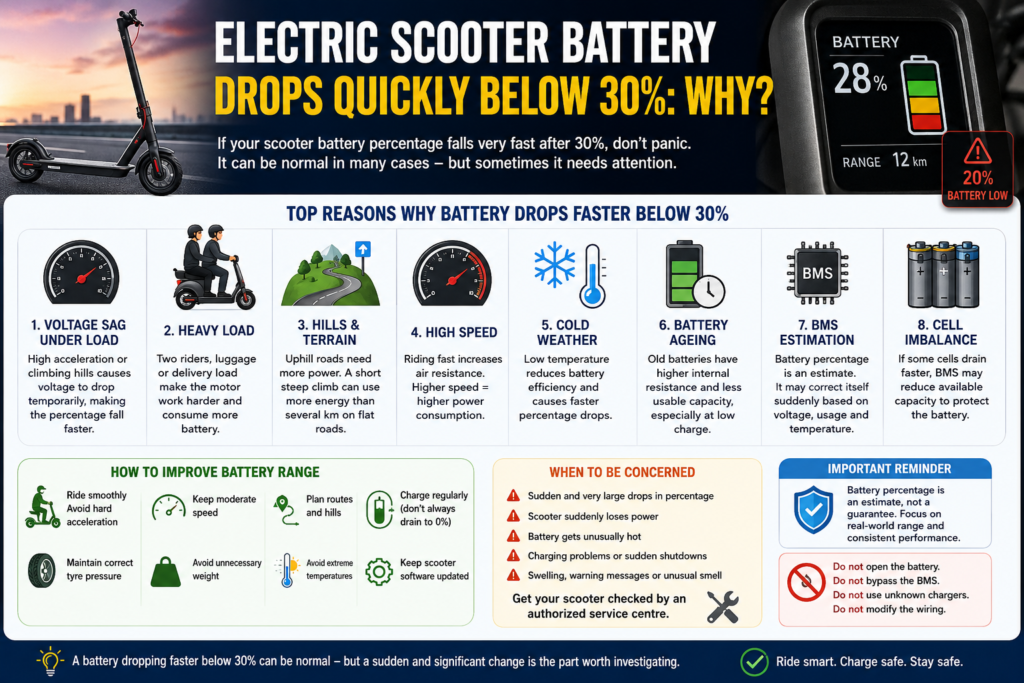
If your electric scooter shows 30% battery and then suddenly drops to 20%, 15%, or even 10% within a short distance, you are not alone. Many EV scooter owners notice that the battery percentage seems to fall normally from 100% to around 40%, but once it reaches the lower range, the percentage can drop much faster.
This behavior can be caused by several different factors. Sometimes it is completely normal battery behavior. In other cases, it can indicate battery ageing, cold weather, high load, inaccurate battery estimation, or a problem with the battery management system.
The important thing is not to judge battery health only by the percentage displayed on the dashboard. The battery percentage is an estimate calculated by the scooter’s electronic system. It does not always represent the exact amount of usable energy remaining inside the battery.
This guide explains why an electric scooter battery may drop quickly below 30%, what causes the problem, how to check whether your battery is healthy, and what you can do to improve the situation.
Why Does the Battery Drop Faster Below 30%?
The first thing to understand is that the battery percentage shown on an electric scooter is not simply a fuel-gauge-style measurement.
An EV battery contains many individual cells connected together. The scooter’s battery management system, commonly called the BMS, monitors voltage, current, temperature and other parameters to estimate the remaining state of charge.
When the battery is nearly full, its voltage remains relatively high. As the battery becomes discharged, voltage gradually decreases. Near the lower end of the battery’s usable range, voltage can change more noticeably, especially when the scooter is under heavy load.
Because of this, the last 20–30% can sometimes appear to disappear faster than the first 50–60%.
For example, a scooter might display:
100% → 80%: appears normal
80% → 50%: appears normal
50% → 30%: slightly faster
30% → 10%: noticeably faster
This does not automatically mean the battery has suddenly lost 20% of its capacity.
The actual energy remaining and the percentage displayed on the dashboard are two related but different things.
1. Battery Voltage Falls More Quickly Under Load
One of the biggest reasons for a sudden percentage drop is voltage sag.
When you accelerate an electric scooter, the motor demands a large amount of current from the battery. The battery voltage can temporarily fall under this load.
This temporary voltage reduction is called voltage sag.
Imagine that your scooter is showing 30% battery while you are riding gently on a flat road. You then open the throttle strongly to overtake another vehicle or climb a flyover.
The motor demands more power.
The battery voltage falls.
The BMS detects the lower voltage and may adjust its estimate of remaining charge.
As a result, you may suddenly see 27%, 25%, or even lower.
When you reduce the throttle and the load decreases, the voltage may recover slightly.
You might then notice that the battery percentage stops falling as quickly.
This is one reason why battery percentage should not be judged from a single acceleration event.
2. The Scooter Is Carrying a Heavy Load
Electric scooters are particularly sensitive to load because their motors must work harder to move additional weight.
If you regularly ride with two people, carry heavy luggage, or use the scooter for delivery work, the battery can discharge faster.
The effect becomes more noticeable when the battery is already below 30%.
Suppose a scooter has 30% remaining and is carrying two adults. When you accelerate from a standstill, the motor needs considerably more power than it would with a single rider.
The battery experiences higher current demand.
This can cause:
- Faster energy consumption
- Greater voltage sag
- More noticeable battery percentage changes
- Lower real-world range
- Higher motor and battery temperatures
Therefore, a battery that appears to drop quickly below 30% with two riders may behave much better with one rider on a flat road.
3. Hills Can Make the Problem Look Worse
Riding uphill is one of the biggest battery consumers for an electric scooter.
The motor has to overcome gravity in addition to rolling resistance and air resistance.
If your scooter shows 30% battery before climbing a hill, the percentage can fall surprisingly quickly during the climb.
For example, a short but steep hill can consume more energy than several kilometres of relaxed riding on a flat road.
This is particularly important with smaller electric scooters that have lower battery capacity and less powerful motors.
If the battery drops rapidly only during uphill riding, it does not necessarily indicate a defective battery.
The scooter is simply using more energy.
4. High-Speed Riding Consumes More Energy
Speed has a major effect on electric scooter efficiency.
At higher speeds, aerodynamic resistance increases significantly. The motor therefore needs more power to maintain speed.
A scooter travelling at moderate urban speeds may deliver much better efficiency than the same scooter being ridden continuously at its maximum or near-maximum speed.
The effect can become more noticeable when the battery is below 30%.
If you ride aggressively during the final part of the battery, the remaining percentage may fall quickly.
For example, repeated hard acceleration, high-speed cruising and sudden braking can make the final 20–30% disappear much faster than gentle city riding.
5. Cold Weather Can Reduce Available Performance
Temperature also affects lithium-ion batteries.
Battery cells generally perform best within a moderate temperature range. When the battery becomes cold, its ability to deliver power can temporarily decrease.
A cold battery can show:
- Reduced range
- Greater voltage sag
- Lower acceleration
- Faster-looking percentage drops
- Reduced regenerative braking performance
If the scooter is used in a cold environment or parked outside overnight, you may notice unusual behavior when starting the ride.
The good news is that some temperature-related effects are temporary.
Once the battery reaches a more suitable operating temperature, performance can improve.
In hot climates, excessive battery temperature can also affect performance and battery protection systems may reduce available power.
6. Battery Ageing Can Make the Drop More Noticeable
Battery ageing is another important possibility.
Lithium-ion batteries gradually lose usable capacity as they go through charging and discharging cycles.
A new battery might provide a certain amount of usable energy. After years of use, the same battery may provide less.
This means that the scooter can reach the low-battery region sooner.
Ageing can also increase the battery’s internal resistance. When the motor demands high current, the voltage can then fall more noticeably.
This can make an older battery appear to drop rapidly below 30%.
However, battery ageing is gradual. A sudden dramatic change in behavior overnight is more likely to require further investigation.
7. Battery Percentage Calibration May Be Inaccurate
Sometimes the battery itself is not the main problem.
The battery percentage shown on the dashboard is an estimate.
The BMS uses information such as battery voltage, current flow, temperature and charging history to calculate this estimate.
Over time, the displayed percentage can become less accurate.
For example, your scooter may show 35% when the actual usable energy is lower than expected.
Then, as the scooter continues riding, the BMS updates its calculation and the percentage drops quickly.
This can create the impression that the battery suddenly loses energy.
The battery may not actually be losing energy unusually quickly. The display may simply be correcting its estimate.
8. Battery Cells May Become Unbalanced
An electric scooter battery pack contains multiple cells.
Ideally, the cells should remain at similar states of charge. However, as the battery ages, differences between individual cells can become more noticeable.
If one group of cells reaches a low-voltage limit earlier than the others, the BMS may need to protect the battery.
This can cause:
- Sudden percentage drops
- Reduced range
- Reduced power near low charge
- Early low-battery warnings
- Unexpected power reduction
Cell imbalance is more serious than normal percentage variation and should be checked by a qualified EV technician if the symptoms are persistent.
Do not open the high-voltage battery pack yourself.
9. The Battery Management System May Be Limiting Power
The BMS is designed to protect the battery.
It monitors the battery continuously and can reduce available power when conditions become unsafe or unsuitable.
Depending on the scooter design, protection may become more noticeable when:
- Battery voltage is low
- Battery temperature is too high
- Battery temperature is too low
- Current demand is excessive
- Cell voltage becomes abnormal
- The battery is significantly discharged
When the battery approaches a low state of charge, the scooter may intentionally reduce performance.
You may notice slower acceleration or reduced top speed.
This does not necessarily mean the battery has suddenly failed.
It may simply be the scooter protecting the remaining battery energy.
10. Regenerative Braking Can Affect the Display
Some electric scooters use regenerative braking.
During certain deceleration events, the motor can act as a generator and send some energy back toward the battery.
However, regenerative braking does not always operate at the same level.
When the battery is close to full, the scooter may limit regeneration because there is less room to accept additional energy.
At low battery levels, regeneration may work differently depending on the scooter’s software, battery temperature and operating conditions.
Therefore, riding style and regenerative braking behavior can also affect how quickly the displayed percentage changes.
11. Tyre Pressure Can Increase Battery Consumption
Low tyre pressure is an easy problem to overlook.
When tyres are underinflated, rolling resistance increases.
The motor has to work harder to move the scooter.
This means more battery energy is consumed for the same distance.
The effect may be small on a single ride, but it can become significant over many kilometres.
Always maintain tyre pressure according to the scooter manufacturer’s recommended specification.
Do not simply inflate the tyres to the maximum pressure printed on the tyre unless that matches the scooter manufacturer’s recommendation.
12. Brake Drag Can Drain the Battery
A partially dragging brake can also reduce range.
If a brake pad or brake mechanism is continuously rubbing against the wheel, the motor has to overcome additional resistance.
You may not notice it immediately.
But if the scooter feels unusually heavy to push or the range has suddenly decreased, brake drag is worth checking.
After a normal ride, an unusually hot wheel or brake component can also be a warning sign.
Do not touch hot brake components immediately after riding.
13. Road Conditions Matter
Your electric scooter’s claimed range is normally measured under controlled conditions.
Real roads are different.
You may encounter:
- Traffic
- Speed breakers
- Rough roads
- Potholes
- Hills
- Stop-and-go riding
- Headwinds
- Heavy traffic
- Frequent acceleration
- Two riders
All of these factors can increase energy consumption.
Therefore, a scooter that normally travels 20 km after reaching 30% battery under easy conditions may travel significantly less under difficult conditions.
14. Headwind Can Reduce Range
Wind is another factor that many riders ignore.
If you ride into a strong headwind, the scooter has to push through additional air resistance.
You may maintain the same speed but use more power.
This is especially noticeable at higher speeds.
A strong headwind can make the battery percentage fall faster even when the road is flat.
If the battery behaves normally on calm days but drops faster on windy days, the battery itself may not be the problem.
15. Frequent Hard Acceleration Is a Major Factor
Electric motors deliver strong torque almost instantly.
This makes electric scooters quick and enjoyable to ride.
However, repeated hard acceleration consumes more energy.
For example:
Starting aggressively at every traffic light
Accelerating to maximum speed
Braking heavily
Accelerating again
can consume much more energy than smooth acceleration.
If you want maximum range from the final 30% battery, use gradual acceleration and maintain a steady speed where possible.
16. Why Does 30% Sometimes Feel Like 15%?
This is one of the most common questions from EV riders.
The answer is that battery percentage is not always perfectly linear.
A battery does not necessarily deliver exactly one-third of its practical range between 30% and 0%.
The usable energy depends on:
- Battery temperature
- Current demand
- Battery age
- Cell condition
- Riding speed
- Motor load
- Terrain
- Software calibration
The scooter manufacturer may also keep a reserve at the bottom of the battery.
Therefore, when the dashboard reaches 10%, the actual battery pack is not necessarily physically empty.
The BMS may reserve some energy to protect the cells.
Is It Normal for an Electric Scooter to Drop Quickly Below 30%?
A small difference in discharge rate can be normal.
For example, you may notice that the battery falls somewhat faster below 30%, especially during acceleration or climbing.
That alone is usually not enough to conclude that the battery is damaged.
However, a very sudden change should not be ignored.
If your scooter normally travels 20 km from 30% to 10% but suddenly travels only 5 km under the same conditions, something may have changed.
Possible causes include battery ageing, calibration problems, cell imbalance, temperature, tyre pressure, brake drag or another mechanical/electrical issue.
How to Check Whether the Battery Is Actually Weak
The best way to investigate the problem is to compare real-world distance rather than watching the percentage every few seconds.
Choose a familiar route.
Try to test under similar conditions:
- Same rider
- Similar tyre pressure
- Similar speed
- Similar weather
- Similar traffic
- Similar route
- Similar riding mode
Start with a reasonably high battery level and record the distance travelled.
Repeat the test more than once.
A single ride is not enough to diagnose battery health.
Test 1: Check Battery Behaviour on a Flat Road
Find a safe, relatively flat route.
Avoid aggressive acceleration.
Ride at a moderate and consistent speed.
Observe how the battery percentage changes.
If the battery drops smoothly, the scooter is probably behaving normally.
If the percentage suddenly falls by a large amount without a clear reason, further investigation may be useful.
Test 2: Compare Gentle and Aggressive Riding
Perform two rides under similar conditions.
During the first ride, use smooth acceleration and moderate speed.
During the second ride, use stronger acceleration and higher speeds.
If the battery percentage falls significantly faster during aggressive riding, the difference may simply be caused by energy consumption and voltage sag.
Test 3: Check the Scooter With One Rider
If you normally ride with two people, perform a test with only one rider.
A lighter load reduces the power required by the motor.
If the low-battery drop becomes much less noticeable, rider and load conditions are likely contributing to the problem.
Test 4: Check Tyre Pressure
Before testing range, check both tyres.
A small pressure difference can affect rolling resistance.
Use the recommended pressure specified for your scooter.
Do not compare range before and after tyre inflation unless the other riding conditions are reasonably similar.
Test 5: Look for Unusual Heat
After a ride, pay attention to unusual heat from the scooter.
The battery, motor and controller naturally produce heat during operation.
But excessive or unusual heating can indicate that the scooter is working under high load or that a component requires inspection.
Never open the battery pack to investigate it yourself.
When Should You Be Concerned?
A rapidly falling battery percentage deserves more attention if it is accompanied by other symptoms.
For example:
- The scooter suddenly loses power.
- Range has dropped dramatically.
- Battery percentage jumps up and down.
- The scooter switches off unexpectedly.
- A battery warning appears.
- Charging stops unexpectedly.
- The battery becomes unusually hot.
- The scooter refuses to charge normally.
- The battery percentage remains stuck for a long time and then suddenly drops.
- The problem happens repeatedly under normal riding conditions.
If several of these symptoms occur together, contact the manufacturer’s service centre or a qualified EV technician.
Can Software Updates Fix Battery Percentage Problems?
Sometimes they can.
Electric scooters rely heavily on software for battery estimation, motor control and energy management.
Manufacturers can improve battery estimation through software updates.
An update may change:
- State-of-charge calculation
- Power delivery
- Regenerative braking
- Low-battery behavior
- Range estimation
- Thermal management
If your scooter manufacturer has released an official software update, keeping the scooter updated can be useful.
However, software should not be assumed to be the solution for every battery problem.
A damaged or ageing battery requires proper diagnosis.
Should You Fully Discharge the Battery to 0%?
Regularly draining a lithium-ion EV battery completely is generally not a good practice.
You do not need to wait until the scooter reaches 0% before charging it.
Frequent deep discharge can place additional stress on the battery.
For normal daily use, following the manufacturer’s recommended charging procedure is the better approach.
If the manufacturer specifically recommends a particular calibration procedure, follow that procedure rather than relying on generic battery advice.
Does Charging to 100% Improve Battery Percentage Accuracy?
It can sometimes help the battery management system update its state-of-charge estimate, depending on the scooter’s design and software.
However, you should follow the manufacturer’s charging guidance.
Do not repeatedly charge to 100% solely because you think the display is inaccurate unless that is consistent with the manufacturer’s recommendations.
A battery calibration procedure, when supported, should be performed according to the scooter manufacturer’s instructions.
Should You Charge When the Battery Reaches 30%?
There is no universal rule that every electric scooter must be charged at exactly 30%.
The ideal charging pattern depends on the battery chemistry, battery management system and manufacturer’s recommendations.
For everyday use, avoiding unnecessary deep discharge is generally sensible.
If you need the scooter for a long journey, charging before the battery becomes very low is also practical because it provides a safety margin.
Why Does Range Become Unpredictable at Low Battery?
Range estimation becomes more difficult as the battery gets lower.
The scooter’s computer has to predict how much usable energy remains while considering current riding conditions.
If you suddenly climb a hill, accelerate hard or ride into a headwind, energy consumption can increase.
The estimated remaining range may therefore change quickly.
This is why the remaining-kilometres number on the dashboard should be treated as an estimate, not a guarantee.
Battery Percentage vs Remaining Range
These two numbers are not the same.
Battery percentage tells you an estimated state of charge.
Remaining range attempts to predict how far you can travel with that energy.
For example, the scooter might show:
Battery: 30%
but the estimated range could change from:
35 km → 28 km → 24 km
depending on your recent riding behavior.
The range estimate is influenced by recent energy consumption.
Therefore, a sudden change in range prediction does not automatically mean the battery has suddenly lost capacity.
Why the Problem Is More Noticeable on Small Battery Scooters
Electric scooters with smaller battery packs have less energy available.
Suppose one scooter has a relatively small battery and another has a much larger battery.
The same hill, rider weight and acceleration pattern may consume a similar amount of energy in absolute terms, but that energy represents a larger percentage of the smaller battery.
Therefore, percentage drops can appear more dramatic on scooters with smaller battery packs.
Does Battery Age Always Mean Replacement?
No.
Battery ageing is normal.
A battery can continue working for years even after losing some capacity.
Replacement should be considered based on actual battery health, range and manufacturer diagnosis rather than age alone.
If your scooter still provides useful range and operates normally, a moderate reduction in capacity does not necessarily mean replacement is required.
How Long Does an Electric Scooter Battery Last?
There is no single lifespan that applies to every scooter.
Battery life depends on:
- Cell chemistry
- Battery size
- Charging habits
- Temperature
- Number of cycles
- Depth of discharge
- Storage conditions
- Riding load
- Battery management system
A battery used gently in suitable conditions can behave differently from one exposed to frequent deep discharge, extreme temperatures and heavy loads.
Instead of focusing only on the number of years, look at actual capacity and performance.
Can Fast Charging Cause Faster Battery Ageing?
High charging power can generate more heat, depending on the battery system and charging conditions.
Battery manufacturers design charging systems to operate within specified limits.
However, heat is an important factor in battery ageing.
If your scooter supports fast charging, use the approved charger and charging system.
Avoid using incompatible chargers or unofficial modifications.
Is It Safe to Continue Riding When the Battery Drops Quickly?
It depends on the cause.
If the battery simply decreases somewhat faster below 30% and the scooter otherwise behaves normally, it may not be a safety issue.
But if the battery percentage is accompanied by unusual heat, swelling, warning messages, sudden shutdowns, charging problems or severe power loss, stop treating it as a simple range issue.
Have the scooter inspected.
Never continue using a battery that appears physically damaged or swollen.
What You Should Not Do
Do not open the battery pack yourself.
Do not bypass the BMS.
Do not connect an unknown charger.
Do not modify battery wiring.
Do not replace individual cells without proper battery engineering knowledge and equipment.
Do not ignore repeated battery warning messages.
High-voltage lithium-ion battery packs can be dangerous if improperly handled.
Battery diagnosis and repair should be performed by trained professionals using appropriate equipment.
How to Improve Low-Battery Range
If your scooter is mechanically and electrically healthy, several riding habits can help.
Ride Smoothly
Avoid repeated full-throttle acceleration.
Smooth acceleration generally uses less energy.
Maintain Moderate Speed
High speed increases energy consumption.
If maximum range is your priority, moderate speeds are usually more efficient.
Maintain Correct Tyre Pressure
Check tyre pressure regularly.
Correct pressure reduces unnecessary rolling resistance.
Reduce Unnecessary Weight
Carrying unnecessary luggage increases the load on the scooter.
Remove items you do not need for daily riding.
Plan Hills and Long Routes
If possible, avoid reaching very low battery levels before a long climb.
Keep additional battery reserve for difficult sections of the route.
Avoid Extreme Temperatures
Park the scooter in a suitable location whenever possible.
Extreme heat and cold can affect battery performance.
A Simple Example
Imagine an electric scooter starts a ride at 50%.
The rider travels smoothly on a flat road.
The battery reaches 30% after 15 km.
The rider then enters heavy traffic, carries a passenger and climbs several flyovers.
The battery drops from 30% to 15% in only 7 km.
It may appear that something is wrong with the battery.
But the riding conditions have changed significantly.
The scooter is now consuming more energy per kilometre.
Now imagine the same scooter repeatedly drops from 30% to 5% after only 2–3 km while riding alone on a flat road at moderate speed.
That would be much more unusual and would justify a battery health inspection.
What Does a Healthy Battery Usually Feel Like?
A healthy battery does not have to produce a perfectly linear percentage decrease.
Instead, look for consistent behavior.
A healthy scooter should generally:
- Provide predictable range
- Deliver normal acceleration
- Charge normally
- Avoid unexpected shutdowns
- Avoid extreme battery temperature
- Show reasonably consistent battery readings
Small changes from ride to ride are normal.
Large and repeated changes under similar conditions deserve attention.
The Most Important Point: Don’t Judge Battery Health From 30% Alone
Seeing the battery drop quickly below 30% does not automatically mean the battery is damaged.
There are many possible explanations.
The most common are:
- Higher power demand.
- Voltage sag.
- Hills.
- High-speed riding.
- Heavy rider or passenger load.
- Cold or hot battery temperature.
- Tyre pressure.
- Battery ageing.
- Battery percentage calibration.
- Cell imbalance or another battery problem.
The key is to identify whether the behavior is consistent and explainable or sudden and abnormal.
Frequently Asked Questions
Why does my electric scooter go from 30% to 20% very quickly?
The most common reasons are increased power demand, voltage sag, hills, high speed, heavy load or inaccurate state-of-charge estimation. If it happens repeatedly under normal conditions, have the battery checked.
Is 30% battery actually 30% usable energy?
Not necessarily. The dashboard percentage is an estimate produced by the battery management system. The displayed percentage does not always correspond perfectly to a simple percentage of usable energy.
Why does my scooter lose battery faster with two riders?
The motor needs more energy to move a heavier load, especially during acceleration and uphill riding. This can also increase voltage sag.
Can low tyre pressure cause fast battery drain?
Yes. Underinflated tyres increase rolling resistance and can reduce range.
Does riding fast drain an electric scooter battery?
Yes. Higher speeds generally require more power, particularly because aerodynamic resistance increases with speed.
Can an old battery suddenly drop from 30% to 10%?
Battery ageing can make low-charge behavior worse, particularly because internal resistance may increase. However, a sudden major change should be investigated rather than automatically blamed on age.
Is fast battery percentage drop dangerous?
Not always. A small or predictable increase in discharge rate can be normal. Sudden shutdowns, unusual heat, swelling, charging problems or warning messages are more concerning.
Should I replace the battery if it drops quickly below 30%?
Not immediately. First check riding conditions, tyre pressure, temperature and actual range. If the problem continues, ask the manufacturer’s service centre to check battery health and cell balance.
Can a software update fix the problem?
Sometimes software updates can improve battery estimation and energy management. But they cannot repair physically degraded or damaged battery cells.
Should I ride until 0% to test the battery?
It is better not to repeatedly perform deep-discharge tests. Use the manufacturer’s recommended procedure for battery testing or calibration.
Why does the battery percentage sometimes increase after stopping?
Voltage can recover when the battery is no longer under heavy load. The BMS may then update its estimate, causing the displayed percentage to change slightly.
Final Verdict
If your electric scooter battery drops quickly below 30%, don’t immediately assume that the battery is failing.
In many cases, the combination of high power demand, voltage sag, hills, speed, rider weight and battery temperature makes the lower battery percentage disappear faster.
However, if the behavior is new, extreme or happens repeatedly during normal riding, battery ageing, cell imbalance, calibration problems or another electrical issue may be involved.
The best way to judge battery health is to look at the scooter’s real-world range and behavior under similar riding conditions, rather than focusing only on the percentage shown on the dashboard.
Keep tyre pressure correct, ride smoothly, avoid unnecessary deep discharge, follow the manufacturer’s charging instructions and keep the scooter’s software updated.
Most importantly, never open or modify a lithium-ion scooter battery yourself. If you notice sudden shutdowns, abnormal heating, swelling, charging problems or major range loss, get the battery inspected by an authorized service centre or qualified EV technician.
A battery dropping faster below 30% can be completely normal—but a sudden and significant change from your scooter’s previous behavior is the part worth investigating.